
《TTC TTC course big history 大历史 精品视频课程》(big history )
电驴资源
电驴资源简介
| 资源介绍 |
| 英文名: big history |
| 发行日期: 2009年 |
| 中文名: TTC TTC course big history 大历史 精品视频课程 |
| 对白语言: 英语 |
| 地区: 美国 |
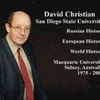
简介:  Description Description TTC Video - Big History: The Big Bang, Life on Earth, and the Rise of Humanity Professor: David Christian COURSE DESCRIPTION About 100,000 to 60,000 years ago, a species of hominines�bipedal ape-like creatures�began to move out of its home territory in Africa and into the Asian continent. Today, homo sapiens, the descendants of those first hominines�live in nearly every ecological niche. We fly through the air in planes, communicate instantaneously over immense distances, and develop theories about the creation of the Universe. In Big History: The Big Bang, Life on Earth, and the Rise of Humanity, you�ll hear this ever-evolving story�the history of everything�in its monumental entirety from the moment the Universe grew from the size of an atom to the size of a galaxy in a fraction of a second. Read more at http://ebookee.org/Description-TTC-Video-B...DU0To.99 1What Is Big History?Most history courses cover time spans of a few decades or a few centuries, but big history requires us to survey the past over scales that span billions of years. This lecture explores ways to become more familiar with the immense scales needed to cover the modern creation story. 2Moving across Multiple ScalesIn this lecture, we introduce one of the unifying themes of the course: the development of increasing complexity since the creation of the Universe. Here, we'll examine the definition of complexity and ask how our Universe builds more complex entities. 3Simplicity and ComplexityWhy should we trust the claims of modern science about events in the distant past? This lecture lays some ground rules about evidence for proving scientific claims and describes how new dating techniques have allowed scientists to peer further back into the past than previously thought possible. 4Evidence and the Nature of ScienceWe encounter the first threshold of complexity—the creation of the Universe at the moment of the big bang—and explore the scientific evidence that allows us to piece together this ever-evolving story of creation. 5Threshold 1—Origins of Big Bang CosmologyThis lecture surveys the history of different ideas about the creation of the Universe, from Ptolemaic theories of an Earth-centered cosmos to the modern notion of a constantly expanding Universe. 6How Did Everything Begin?How did the Universe change from a cloud of dust to a constellation of stellar bodies? This lecture describes how gravity was fundamental in crossing the second threshold of the course: the creation of stars and galaxies from huge clouds of hydrogen and helium atoms. 7Threshold 2—The First Stars and GalaxiesStars created the preconditions for crossing a third threshold of complexity: the formation of chemical elements. As stars collapse and die, they fuse to create new atoms that are the building blocks of all the complex chemicals that make up our Earth. 8Threshold 3—Making Chemical ElementsWith this lecture, we shift from the scale of the Universe to that of our solar system. Here we examine the processes by which planets and solar systems are created and the evidence that helps us piece together this part of the story. 9Threshold 4—The Earth and the Solar SystemThe tumultuous early history of the Earth is presented in this lecture, including the development of our planet's internal layers, the generation of its magnetic field, the creation of the first seas, and the appearance of its early atmosphere. 10The Early Earth—A Short HistoryIn this lecture, we examine the history of the Earth's surface and learn how the notion of our planet as fixed and unchanging was eventually overturned by a new vision of the Earth's crust as broken into plates that are constantly on the move. 11Plate Tectonics and the Earth's GeographyWith the consideration of the next threshold of complexity, life, we develop a definition of life itself, and begin to consider how life-forms adapt and change over time. 12Threshold 5—LifeIn On the Origin of Species, Charles Darwin revealed a new story: an account of how all living species change and adapt. This lecture recounts how Darwin arrived at his revolutionary theory, and how he shared his ideas with contemporaries who were making similar breakthroughs. 13Darwin and Natural SelectionIn this lecture, we examine the various kinds of evidence Darwin used to establish his theory of natural selection, including the fossil record, similarities among species, and the geographic distribution of species. We also review modern evidence of natural selection. 14The Evidence for Natural SelectionHow was life first created from non-life? Modern biologists tell a complex story of the creation of life which involves the development of organic matter from simpler molecules such as amino acids, nucleic acids, sugars, and proteins. 15The Origins of LifeHow was life first created from non-life? Modern biologists tell a complex story of the creation of life which involves the development of organic matter from simpler molecules such as amino acids, nucleic acids, sugars, and proteins. 16Life on Earth—Single-celled OrganismsThe fusion of single-celled organisms into larger, multi-celled organisms c. 600 million years ago marked a turning point in the development of life forms on this planet. In this lecture, we focus on the evolution of multi-cellular organisms, tracing four evolutionary steps leading to our own species, Homo sapiens. 17Life on Earth—Multi-celled OrganismsHow did modern humans evolve from ape-like ancestors? This lecture surveys the evolution of primates and great apes, and then traces the adaptive development of hominines, a group of bipedal primates that appeared in Africa 7 million years ago. 18HomininesTo construct the story of hominine evolution, scientists rely on three kinds of evidence: archaeological evidence, evidence based on the study of modern primates, and evidence based on genetic comparisons between modern species of primates, including ourselves. 19Evidence on Hominine EvolutionHuman beings represent a new threshold of complexity in the story of life on Earth. In this lecture, we examine two things that make us unique: use of symbolic language and collective learning. 20Threshold 6—What Makes Humans Different?Does the archaeological record reveal when the first members of our species appeared? In this lecture, we examine evidence from the Stone Age and consider several theories of the early history of the first humans. 21Homo sapiens—The First HumansUsing remains left behind by our ancestors and studies of modern societies that still use stone technologies, modern researchers have constructed a portrait of the Paleolithic way of life. In this lecture, we enter into this world and learn what life was like for our distant ancestors. 22Paleolithic LifewaysChange was gradual over the course of the long Paleolithic era, but there were some significant shifts that altered lifeways for human beings. These include climate changes during two ice ages, the rise of various technological innovations, and adaptive migration to nearly all parts of the globe. 23Change in the Paleolithic EraThe appearance of agriculture set human history off in entirely new directions by increasing human control of food, energy, and other resources. The development of agriculture brings about changes in the environment and lays the foundation for the development of more complex human societies. 24Threshold 7—AgricultureWhy, after 200,000 years of foraging, should human communities in quite different parts of the world take up agriculture almost simultaneously? In this lecture, we explore the different factors leading to this innovation. 25The Origins of AgricultureAlthough early agrarian societies left behind no written record, there is evidence of many important new developments during this period. Here, we explore the lifeways of these societies, and question whether agriculture meant the early farmers lived better than their forager ancestors. 26The First Agrarian SocietiesApproximately 5,000 years ago, the human species saw the rise of a new form of social organization: the first "tribute-taking" states. We begin our consideration of these states by asking how power is defined and what forms it takes. 27Power and Its OriginsHow did humankind move from kinship clans and small agricultural villages to enormous centralized societies? This lecture surveys the archaeological and anthropological evidence used to reconstruct the evolution of power structures and theorizes how these larger societies took shape. 28Early Power StructuresThis lecture introduces the 5,000 years of human history that were dominated by the huge and powerful societies: agrarian civilizations. With the development of writing, we get the first era of recorded history. 29From Villages to CitiesHow did the buildup of human and material resources during the early Agrarian era lead to the development of the first tribute-taking states and the first real cities? Here, we'll examine one of the earliest agrarian civilizations, Sumer in southern Mesopotamia, to learn how these new developments arose. 30Sumer—The First Agrarian CivilizationHow typical was Sumer of agrarian civilizations in general? This lecture briefly surveys six different areas where agrarian civilizations appeared early, including northeastern Africa, northern India, China, and the Americas. 31Agrarian Civilizations in Other RegionsDespite the limited contact among them, early agrarian civilizations the world over shared many features. In this lecture, we'll examine these features and speculate why agrarian societies seem to develop along similar lines despite regional differences. 32The World That Agrarian Civilizations MadeIn this lecture, we begin to take the long view of agrarian civilizations, marking two trends that occurred during the course of 4,000 years: the expansion of civilizations to cover larger regions and incorporate more people, and the increasing power and reach of their rulers. 33Long Trends—Expansion and State PowerAgrarian civilizations were able to expand because they developed new ways to extract resources and manage populations. This lecture examines how features such as population growth, commerce, and tribute-taking states helped encourage innovation. 34Long Trends—Rates of InnovationThroughout human history, we see periods of innovation, population growth, increasing trade and urbanization, political expansion, and cultural efflorescence. Then, sometimes quite suddenly, there is a crash. In this lecture, we examine the factors that contribute to this cycle of boom and crash, referred to as the Malthusian cycle. 35Long Trends—Disease and Malthusian CyclesThe previous two lectures describe factors that both stimulated and limited growth in the era of agrarian civilizations in Afro-Eurasia, the largest of the four world zones of human history. Here, we begin to question whether these same features and processes appear in American, Australasian, and Pacific zones. 36Comparing the World ZonesIn this lecture, we see that American agrarian civilizations experienced many of the same developments as those in Afro-Eurasia, but these developments appeared much later and never spread as far as in other world region. 37The Americas in the Later Agrarian EraIn the last millennium, the pace of change accelerated sharply and decisively. Since then, humankind has experienced a number of astonishing changes, including accelerating innovation, the formation of larger and more complex societies, the integration of the four world zones, and the growing human impact on the biosphere. 38Threshold 8—The Modern RevolutionThis lecture describes the medieval Malthusian cycle, which lasted from the decline of the Roman and Han Empires to the time of the Black Death. We will focus on Afro-Eurasia, the largest and most significant of the four world zones, and the region that drove change in the early stages of the Modern Revolution. 39The Medieval Malthusian Cycle, 500–1350During the Early Modern cycle, for the first time in human history, the four world zones became linked through global exchange networks which stimulated both commerce and capitalism. Yet for other world zones, these changes were catastrophic, bringing disease and population collapse. 40The Early Modern Cycle, 1350–1700By 1700, many elements of modernity seemed to be in place, yet global rates of innovation remained slow. This lecture describes the breakthrough to modernity after 1700, focusing on one country, Britain, where the transformation has been studied most intensively. 41Breakthrough—The Industrial RevolutionWithin just two centuries, industrialization had transformed the entire world. No earlier transformation in human history had been so rapid or so far-reaching. This lecture describes the impact of industrialization before 1900. 42Spread of the Industrial Revolution to 1900In this lecture, we examine the hallmark events of the 20th century, including major worldwide wars, two waves of innovation, huge population growth, and an enormous surge in energy use. 43The 20th CenturyIn this lecture, we attempt to describe, as we did for Paleolithic and agrarian societies, the lifeways of the Modern era. What emerges is a portrait of a single, world-spanning community of more than 6 billion people supported by ever-increasing technological innovation. 44The World That the Modern Revolution MadeHow has our increasing power over the natural world affected our relationship to planet Earth? Are we becoming a malignant presence within the biosphere, driving other species to extinction and impacting global climactic systems in unpredictable ways? 45Human History and the BiosphereAfter surveying 13 billion years, can we resist peering into the future? We take a tantalizing glimpse into speculations about which historic trends may continue into the next century. 46The Next 100 YearsOur speculations into future developments continue with an examination of several theories about what life will be like 1,000 years in the future. Then we'll jump even further ahead, with scientific theorization about the ultimate fate of the Universe. 47The Next Millennium and the Remote FutureIn the final lecture of this course, we pause to ask some fundamental questions about meaning: What is the place of human beings in the Universe? Are we, perhaps, the only creations of the Universe that have consciousness? 48Big History—Humans in the Cosmos |
| 别名: 大历史 |