
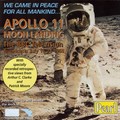
BBC -《阿波罗11号登月实录》(Apollo 11 Moon Landing (1969 BBC Television Coverage))Soundtrack / Live[MP3]
电驴资源
| 用户共享的电驴资源列表 | |
|---|---|
| Apollo.11.Moon.Landing.The.BBC.Television.Broadcasts.July.16–24,.1969.zip | 80.04 MB |
| 80.04 MB | |
电驴资源简介
简介:

British television coverage of Apollo 11, man's first mission to land on the moon, lasted from 16 to 24 July 1969 . All the then three UK channels BBC1, BBC2 and ITV provided extensive coverage. Most of the footage covering this historic event from a British perspective though has now been either wiped or lost
BBC television coverage of Man’s first landing on the moon consisted of 27 hours of coverage over a ten day period. The programmes titled Apollo 11 were broadcast from Lime Grove Studios in London. The BBC2 sections were broadcast in colour and the BBC1 sections in black and white (full colour television in Britain being a few months away). Its main presenter was Cliff Michelmore, with James Burke and Patrick Moore concentrating on scientific and technical explanations and analysis. In America, Michael Charlton reported live from Cape Kennedy and Houston Mission Control.[1] There had been a big build up to the coverage. The Radio Times had a cover with a rocket shooting off and the caption “Target Moon”.[3]
The London studio set of Apollo 11 consisted of a long, angled desk, large models of the moon and the Earth, and a large picture of a rocket against a dark, cosmic - type background. On the front of the desk was a digital clock which counted down the time to lift-off etc. Film animations and models of various parts of the spacecraft helped explain certain stages of the journey. .[1]
Every day of the mission had broadcasts from the space studio. These would vary between long programmes at important points in the mission, such as launching and undocking. But also shorter progress reports, and special moon-centric contributions to news bulletins, children's television and Twenty-Fours Hours, a current affairs show.[1] Programmes in between Apollo 11 reports included But What If It's Made of Green Cheese, an Omnibus anthology broadcast on the night of the moon landing. Rock group Pink Floyd were roped in to provide an exclusive instrumental piece called Moonhead. An audio copy exists of the track and occasionally appears on Pink Floyd bootleg albums.[4] Featured alongside them were distinguished actors of the likes of Ian McKellen, Judi Dench, Michael Hordern and Roy Dotrice all reading quotes and poetry about the moon. The Show also featured Dudley Moore with The Dudley Moore Trio and Jazz singer Marion Montgomery.[5][6] David Bowie's song Space Oddity was also featured as part of the coverage.[7]
Michael Charlton reports for the BBC from Houston Mission ControlThe actual night of the moon landings on 20/21 July was historic also in British TV terms, as it was first ever all night broadcast on British television. With both BBC1 and ITV remaining on air for 11 hours from 11.30pm (July 20) to 10.30am (July 21). Neil Armstrong stepped on to the surface of the moon at 3:56am British time. His comments were interspersed with commentary from James Burke, often to fill in the silences.
John Godson, who was directing the news that night remembered When Neil Armstrong stepped onto the moon's surface, the whole BBC control room, with the canteen ladies and security guards standing beside the vision control desk, exploded into cheering and clapping. To us it had been a similar type of relief as it must have been to Armstrong, his crew and Ground Control. Up to now, nothing had gone wrong. I vividly recall we had Armstrong's ‘One small step’ spiel with very little distortion, considering he was in full lunar gear. I mean, it was easily comprehensible though, shall we say, slightly garbled. It was quite difficult to make any visual sense out of the first pictures from the lunar surface, as I recollect. But under those circumstances we would have had James Burke describe, voice-over, what we were trying to assimilate with our eyes. I was there to direct the situation - to decide when voice-over explanations were required, to be ready to take actions if the picture circuits failed. In fact, it resulted in quite a calm overnight operation with, if I remember correctly, not a single major panic situation other than numerous sound comprehension problems. [8]
The first images from The Moon were upside down, so engineers on Earth operated an electronic switch on receiving the signal to correct the picture. All transmissions from the moon were in black and white. When Buzz Aldrin became the second man on the moon twenty minutes later, the picture quality had improved - after the moon-rise in Australia the signal had moved from the smaller Goldstone in California to the stronger signal received on the main on-axis receiver of the Parkes [9] radio-telescope in Australia, and then relayed via the Honeysuckle Creek station to Sydney for subsequent distribution uplink. The BBC later earned a Queen's Award For Industry for the electronic standards converter, which helped translate the pictures from California, via the Goonhilly Satellite Earth Station in Cornwall to the BBC in London [1]
For several hours after the live event, pictures of the moonwalk were reshown as edited highlights.[1]
Patrick Moore considers it the most exciting event he ever reported on. He said Bridging the gap between two worlds was an awesome achievement. [10] James Burke has said in retrospect that it was The greatest media event of all time .[1] On its tenth anniversary in 1979, he looked back on the whole Apollo programme in two BBC documentaries, The Men Who Walked on the Moon (BBC1) and The Other Side Of The Moon (BBC2, later the same night).[2][11] The producer of those documentaries has written a memoir[12] of BBC tv's Apollo 11 coverage, recalling that the event became a bone of contention between the Science Features Department, which had covered previous space events, including the Apollo 8 mission, and the Current Affairs Department, which had more appropriate resources for staging very big events.
http://en.wikipedia.org/wiki/British_telev...coverage