
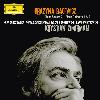
Krystian Zimerman -《格拉齐纳.巴切维茨: 钢琴奏鸣曲No.2;钢琴五重奏Nos.1&2》(Grazyna Bacewicz: Piano Sonata No. 2; Quintets Nos. 1 & 2)[FLAC]
电驴资源
| 用户共享的电驴资源列表 | |
|---|---|
| Krystian.Zimerman.-.[Bacewicz.Piano.Sonata.No.2.Piano.Quintet.Nos.1&2].专辑.(FLAC).rar | 256.28 MB |
| 256.28 MB | |
电驴资源简介
简介:

厂牌:Deutsche Grammophon
作曲: Grazyna Bacewicz
钢琴: Krystian Zimerman
弦乐:Kaja Danczowska;Agata Szymczewska;Ryszard Groblewski;Rafal Kwiatkowski
编号:00289 477 8332
专辑介绍:
作曲家格拉奇娜·巴切维茨(波兰语:Grażyna Bacewicz,1909年2月5日-1969年1月17日),波兰女作曲家,小提琴家。早年在华沙音乐学院学习,后接受帕德雷夫斯基资助赴巴黎师从娜迪亚·布朗热,回国后在乐队演奏小提琴为生。二战后回到罗兹任教,后来因车祸不幸致残。她的作品多为弦乐器而作,体现出浪漫主义的特征,同时也有一定的现代性。
钢琴家Krystian Zimerman生于1956年12月5日生于波兰,1975年,年仅十九岁的Krystian Zimerman赢得Chopin国际钢琴大赛首奖,同时并拿下波兰舞曲和马祖卡舞曲奖,成为该比赛有史以来最年轻的首奖得主(直到2005年,年仅十七岁的李云迪,获得Chopin国际钢琴大赛首奖,方始打破Krystian Zimerman最年轻得主的纪录),也打破从1927年开始举办Chopin钢琴大赛以来,波兰人在Chopin钢琴大赛中始终拿不到好成绩的魔咒(印象里他似乎是截至2005年为止,第一位获得Chopin国际钢琴大赛首奖的波兰人)。 Krystian Zimerman台风稳健,充满灵性的气质,如同Chopin的化身。如果说十九世纪的Chopin,由二十世纪的Alfred Cortot, Artur Rubinstein发扬光大,那么Krystian Zimerman应是二十一世纪Chopin最佳代言人,传承波兰音乐的香火。Krystian Zimerman虽以Chopin成名,但亦试图跳脱Chopin框架,将自己重新定位为全方位的钢琴家。Krystian Zimerman,拓展Chopin以外的曲目,特别是德奥浪漫乐派的作品, Beethoven, Johannes Brahms, Schubert, Schumann等人的作品,已出现在他的录音或演奏曲目上。 Krystian Zimerman行事作风低调的,被称为钢琴界的哲学家,深入钻研乐谱与相关历史资料,不以夸张的诠释讨好听众,故其演奏较少炫彩,犹似与自己对话,细心照顾演奏的每个细节,触键的音色,琴键振动的频率,使其音乐如诗,因而博得「波兰钢琴诗人」之雅号。许多时候Krystian Zimerman选择独语,这也是他被乐评家评为耽溺的由来。
引用Editorial Reviews
From the Artist
Throughout the 1950s and 1960s Grażyna Bacewicz was famous as one of the leading and most forward-looking composers of her generation. Comparisons were drawn with Nadia Boulanger, who had occupied an equally prominent position in the world of music before the Second World War. Today it is Sofia Gubai¬dulina who plays this role on the contemporary classical scene. If Grażyna Bacewicz's music failed to reach a wider international audience, this was due above all to the circumstances in which she lived and worked: during the most creative and productive years of her life as a composer, her native Poland - like all the other countries of the Eastern Bloc - was cut off from developments in the world at large and, more especially, in the world of western culture. Grażyna Bacewicz was born in Łódź on 5 February 1909 and died in Warsaw on 17 January 1969. She was active as a composer, violinist and teacher. She attended the Warsaw Conservatory, where she studied composition with Kazimierz Sikorski and the violin with Józef Jarzębski, graduating in 1932 and at the same time studying the piano with Józef Turczyński, before furthering her composition studies with Nadia Boulanger in Paris and perfecting her violin technique with André Touret and, later, Carl Flesch at the École normale de Musique in Paris. Her studies in Paris were supported by Ignacy Jan Paderewski. Bacewicz's works are exceptionally rich and varied, extending, as they do, to all the different musical genres and forms. But although she wrote symphonic works and instrumental concertos, her great passion was chamber music. Among her contributions to the medium are seven string quartets entirely capable of standing comparison with those of Bartók. Bacewicz was in total command of her métier. Her pieces are invariably notable for their clear and careful formal planning. She worked constantly at refining her musical language. During the interwar years her aesthetic outlook owed much to that of Karol Szymanow¬ski, while also reflecting the influence of French music. In the wake of the Second World War her style became more animated and dynamic, a development arguably due to the influence of Stravinsky, Bartók and Prokof¬iev and to her use of stylized forms of Polish folk music. At the end of the 1950s she made a cautious attempt to adopt a new aesthetic approach that she herself termed avant-garde . Bacewicz's music has all the qualities of an exceptional art. Her formal mastery and technical brilliance have lost none of their ability to dazzle us today. This is a conviction shared by Krystian Zimerman: I'd like to honour a composer to whom I and all the rest of us owe a great deal. I thought about recording the two quintets as long ago as 2002, when I presented Deutsche Grammophon with my recording plans for the next few years. I was still a student when I first got to know Grażyna Bacewicz's works in the 1970s. At that time my repertory included the Second Piano Sonata. This is a work I continue to perform at my recitals, and I should add that wherever I play it, it always goes down very well with audiences. After my recitals I am regularly asked: `Who wrote this music? Where can I get hold of a copy of the score? Are there any recordings?' On 5 February 2009 - the centenary of Bacewicz's birth - Krystian Zimerman gave the first of five concerts devoted exclusively to her music. It took place in her birthplace, Łódź, which was also the birthplace of Artur Rubinstein. The programme for this first concert featured the two Piano Quintets and the Second Piano Sonata. The five concerts were given in Poland's five most important cities: not only Łódź but also Warsaw, Poznań, Cracow and Katowice. In every case the musicians were enthusiastically received. Bacewicz and her formally perfect music returned in triumph to the concert hall. Krystian Zimerman and his four distinguished colleagues brought all their skill and innovative understanding to these works, making them sound freshly minted for the 21st century. Our work in the rehearsal room will always remain lodged in my memory as something unique and unforgettable, says the cellist Rafał Kwiatkowski. To be able to work together on a common goal was not just fantastic but mutually inspiring. I think we were very successful in what we achieved in the field of sonority, tone colour and, more generally, the colourful light that we were able to throw on the music. I have the feeling that we created a very special kind of aesthetic ap¬¬proach. But how could it be otherwise when Krystian Zimerman was at the piano? The violinist Kaja Danczowska had already worked with Krystian Zimerman in the recording studio, notably on pieces by Szymanowski. Asked how she thought the deepest layers and ideas of this music could be reached, she replied: One need only surrender to the composer because everything she wanted to say is writ¬ten into the music. The second violinist, Agata Szym¬czewska, who is also the youngest member of the group, admits that she had previously had little experience of playing chamber music, but after working with artists like Krystian Zimerman and Kaja Danczowska she is firmly convinced that in future the world of chamber music will mean far more to her than it has done until now: I'm very happy I was able to work with musicians like these and to rehearse these exceptionally interesting pieces with them. For me, says the viola player Ryszard Groblew¬ski, the music of Grażyna Bacewicz was already a known quantity, and I was aware of its exceptional quality. That's why it's been a great honour for me to work with Krystian Zimerman and three other brilliant musicians in celebrating this magnificent Polish composer on the occasion of her hundredth anniversary. The two quintets, which I've now got to know in greater detail, are veritable pearls. I hope our recording will help to bring Grażyna Bacewicz's name to the attention of a wider audience. The First Piano Quintet was premiered in 1952 and quickly hailed as a work of exceptional maturity in terms of its musical ideas and the ways in which those ideas are implemented. All four sections are logically interconnected so as to create a four-movement cycle, while also revealing highly personal emotions on the part of the composer. The magisterial musical language reflects the work's classical form. As always with Bacewicz, the composer's technical skills and her understanding of the instruments' range of sonorities are on the very highest level. It is clear that great passion informs this work, a point evident from even the very first bars, in which a lyrical section (Moderato molto espressivo) is contrasted with the iridescent brilliance of the virtuosity and also with the figurative fragments (Allegro). The second section is a scherzo at a markedly faster tempo. It is written as a stylized Polish folk dance, the oberek, a dance of which the composer was particularly fond and which is heard again in the final movement of the Second Piano Sonata. The Second Piano Sonata was written a year later and belongs to the same creative period as the First Piano Quintet. Both works share a similar neoclassical form, a comparable post-Romantic range of expression and the use of the oberek. We would be entirely justified in speaking of this work in the same breath as the great piano sonatas of the 20th century, including, for example, the late sonatas of Prokofiev. The three-movement work begins with a Maestoso - Agitato filled with contrasts and emo-tional tensions and built up along the lines of an opening allegro. The highly emotional Largo is reminiscent of the slow movement of the First Piano Quintet, while the final Toccata sweeps the listener along with its virtuosity and energy, the latter produced by its use of the obe¬rek. It was Bacewicz herself who gave the first performance of the Second Piano Sonata, a work that calls on its performer's entire technical arsenal. A few years later the piece was taken into the repertory of Andrzej Jasiński, who subsequently taught Krystian Zimerman and inspired his famous pupil with an abiding love of this extraordinary work. The two piano quintets were written thirteen years apart. The second of them dates from 1965 and is generally regarded as one of the most important of all her contributions to the medium. It also represents a change of aesthetic direction for its composer: as she admitted at the time, she was now moving towards the avant-garde and the world of dodecaphony, aleatory features and complex tone colours. Formally speak¬ing, the work harks back to Classical models. But it achieves its sense of cohesion by dint of its uninhibited flood of sounds, most frequently in the form of individual motifs and brief phrases which, one after the other, are carried forward by the different instruments. A lot happens in my music, Grażyna Bacewicz once explained. It's aggressive and at the same time lyrical. This says all that needs to be said about her music. There is indeed much that happens in it, and even though several decades have now passed since it was written, it continues to exert a powerful fascination on listeners and performers alike. Jan Popis
Product Description
Pianist Krystian Zimerman returned to the recording studio after a five-year absence to celebrate the 100th birthday of the foremost female Polish composer of the 20th century, Grażyna Bacewicz. This album features two hugely imaginative piano quintets and the forceful Second Piano Sonata that Krystian Zimerman performed at the Salzburg Festival in 2008 to rhapsodic reviews. Die Presse wrote: One is . . . unlikely to experience anywhere else Polish music of such power and charm and, at the same time, such refinement . . . In the Maestoso first movement, Zimerman demonstrated his incredible flexibility, impetuous passages merging directly into supple tenderness without any loss of tension. This album is only Zimerman's third chamber music recording for Deutsche Grammophon - rare music played with rare genius to revelatory effect.
这是齐默尔曼消失5年来发行的在DG的第三张室内乐唱片,这五年齐默尔曼都在参与这位20世纪最有远见的波兰女作曲家的100年诞辰的庆祝活动。08年的萨尔兹堡音乐节上齐默尔曼演奏了这张专辑里两首极有想像力的钢琴五重奏和强力的第二钢琴奏鸣曲。媒体评价第二奏鸣曲的演奏“温暖,有力,高贵而富有魅力”。齐默尔曼在第二奏鸣曲第一乐章中展示了他不可思议的清晰度,将激烈的段落与轻柔处理的地方结合得没有丢失一丝张力。itunes上广泛评价为今年DG公司的最佳唱片。