
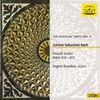
Evgeni Koroliov -《巴哈: 法国组曲》(Bach: French Suites)[2 CD Set][FLAC]
电驴资源
| 用户共享的电驴资源列表 | |
|---|---|
| Evgeni.Koroliov.-.[Bach.French.Suites.(CD.1)].专辑.(Flac).rar | 159.05 MB |
| Evgeni.Koroliov.-.[Bach.French.Suites.(CD.2)].专辑.(Flac).rar | 166.53 MB |
| Evgeni.Koroliov.-.[Bach.French.Suites.(2.CD)].专辑.(Booklet).rar | 1.21 MB |
| 326.79 MB | |
电驴资源简介
| 资源介绍 |
| 专辑中文名: 巴哈: 法国组曲 |
| 语言: 英语 |
| 地区: 美国 |
简介:  专辑介绍: 相较於巴哈同时期以英国样式所作的「英国组曲」, 於1722年左右创作的「法国组曲」的规模较小,但结构更为简洁洗鍊。其中第一至五号组曲收录在巴哈题献给妻子的「安娜‧玛格达莲娜小品集」中,洋溢著温暖的情感、清新优雅的歌唱性,是巴哈作品中最受乐迷喜爱的键盘曲目之一。 出生於莫斯科的钢琴大师伊凡吉尼.柯洛里奥弗(Evgeni Koroliov)在这张录音中弹奏一臺Steinway D-274型钢琴,TACET的王牌录音师Andreas Spreer採用真空管麦克风将现场的空间感与钢琴动人的质感完全真实收录,音色自然透明,迷人至极。 柯洛里奥弗的詮释充满创意,清晰而简洁,运指之间流泄出丰富的感情,已然达到巴哈音乐中的最高境界,此一版本势必掀起一阵疯狂的抢购热潮! Release date: 11-02-2008 Format: CD Genre: Classical Catalogue Number: TACET161 Label: Tacet Era: Other Composer: BACH, JOHANN SEBASTIAN "A merging with the music while forgetting one's self succeeds here, a total concentration in which discipline and zest, regularity and spontaneity are united: a free burning without flickering." (BR klassik) There is little to say about the skill of Evgeni Koroliov, the Russian pianist who has settled in Germany, which has not been said already. Ligeti’s famous saying that he would choose to take Koroliov’s recording of the “Art of Fugue” (TACET 13) to a desert island, where he was "lonely and thirsting", has been frequently quoted; and Koroliov’s almost unbelievable capability of expressing each part in a polyphonic piece as clearly as if it were an individual person has been given many accolades. Those listeners who love his piano performance, and his Bach in particular, need no explanations of how subtly he expresses the nuances of the mood of individual moments and even individual notes. It is for all these people that he has made a new recording of Bach’s French Suites – two CDs for the price of one. Musicians: Evgeni Koroliov, piano 引用J.S. BACH: The Six French Suites, BWV 812-817 – Evgeni Koroliov, piano – Tacet His confidence in the brisk gigues, with quick, ad libitum flourishes in grace notes and apoggiaturas, testifies to his fluid mastery. Published on July 6, 2008 J.S. BACH: The Six French Suites, BWV 812-817 – Evgeni Koroliov, piano – Tacet J.S. BACH: The Six French Suites, BWV 812-817 – Evgeni Koroliov, pian – Tacet 161, (2 CDs) 53:41; 55:06 [www.tacet.de] **: Prior to having auditioned this set of French Suites, I had not known–except perhaps in passing of his prize at the 1973 Van Cliburn Competition–the artistry of Moscow-born Egveni Korliov (b. 1949), whose catalogue for Tacet embraces composers as diverse as Schumann, Schubert, Tchaikovsky, Debussy, and Prokofiev. His is a fine cantabile style, certainly a soft palette that he educes from the Steinway D-274 instrument, non-percussive, and measured for the dynamics between forte and pianissimo. The so-called “French” Suites of Bach–they really are diversely cosmopolitan in their dances as anything else he wrote–survey the elegant possibilities of three major and minor suites, each demanding various kinds of dexterity for arioso and polyphonic realization. That Koroliov basks in their structure and articulate grace is obvious from the outset; and his confidence in the brisk gigues, with quick, ad libitum flourishes in grace notes and apoggiaturas, testifies to his fluid mastery. But as I discovered these works through individual artists like Gilels and Backhaus (on Suite No. 5 in G) and Robert Casadesus’ (on Suite No. 6 in E), what I find lacking in Koroliov is a distinct voice or personality through this otherwise pellucid music. For me, the Backhaus G Major French Suite played as an Italianate excursion; the Gilels was nothing if not spirited French pomp. The Gigue of the E-flat, BWV 815, for instance, rings with happy counterpoint and instrumental brio, but the emotional tone is almost flat, monochromatic; and I find this affective “evenness” evident throughout the set. The menuets are too stiff for my taste. While I admire the security in Koroliev’s playing, his intimate approach to the scores, and his ornamental fluency, there is less than excitement in these stylized performances. I would venture that too much of the Couperin and Rameau influence permeates these suites, except that these musicians, too, need not be–witness Angela Hewitt’s recent contributions–dry pedants. Other auditors – those who may worship at Koroliev’s altar – would likely single out the Bach sarabandes as special moments from him; but even here, too much ceremonial, dirge-like progression can kill even a funeral, wouldn’t you admit? Fine playing, but for the music, I suggest looking elsewhere. – Gary Lemco  
|
| 发行时间: 2008年11月02日 |
| 资源格式: FLAC |
|
专辑曲目: Disc: 1 01. Suite I D minor BWV 812 Allemande 02. Suite I D minor BWV 812 Courante 03. Suite I D minor BWV 812 Sarabande 04. Suite I D minor BWV 812 Menuet I – Menuet II – Menuet I 05. Suite I D minor BWV 812 Gigue 06. Suite II C minor BWV 813 Allemande 07. Suite II C minor BWV 813 Courante 08. Suite II C minor BWV 813 Sarabande 09. Suite II C minor BWV 813 Air 10. Suite II C minor BWV 813 Menuet 11. Suite II C minor BWV 813 Gigue 12. Suite III B minor BWV 814 Allemande 13. Suite III B minor BWV 814 Courante 14. Suite III B minor BWV 814 Sarabande 15. Suite III B minor BWV 814 Anglaise 16. Suite III B minor BWV 814 Menuet – Trio – Menuet 17. Suite III B minor BWV 814 Gigue Disc: 2 01. Suite IV E flat major BWV 815 Allemande 02. Suite IV E flat major BWV 815 Courante 03. Suite IV E flat major BWV 815 Sarabande 04. Suite IV E flat major BWV 815 Gavotte 05. Suite IV E flat major BWV 815 Air 06. Suite IV E flat major BWV 815 Menuet 07. Suite IV E flat major BWV 815 Gigue 08. Suite V G major BWV 816 Allemande 09. Suite V G major BWV 816 Courante 10. Suite V G major BWV 816 Sarabande 11. Suite V G major BWV 816 Gavotte 12. Suite V G major BWV 816 Bourrée 13. Suite V G major BWV 816 Loure 14. Suite V G major BWV 816 Gigue 15. Suite VI E major BWV 817 Allemande 16. Suite VI E major BWV 817 Courante 17. Suite VI E major BWV 817 Sarabande 18. Suite VI E major BWV 817 Gavotte 19. Suite VI E major BWV 817 Polonaise 20. Suite VI E major BWV 817 Bourrée 21. Suite VI E major BWV 817 Menuet 22. Suite VI E major BWV 817 Gigue |
| 版本: [2 CD Set] |
| 古典类型: 全集作品 |
| 专辑英文名: Bach: French Suites |