
《不一样的人,不一样的故事》(Other Voices, Other Rooms)[DVDRip]
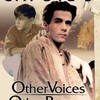
电驴资源
| 用户共享的电驴资源列表 | |
|---|---|
| [不一样的人,不一样的故事].Other.Voices.Other.Rooms.(1997)%(Dvd.Rip).avi | 675.36 MB |
| 675.36 MB | |
电驴资源简介
中文名: 不一样的人,不一样的故事英文名: Other Voices, Other Rooms资源格式: DVDRip发行日期: 1997年导演: David Rocksavage演员: Lothaire Bluteau .... Randolph Skully
Anna Levine .... Amy Skully (as Anna Thomson)
David Speck .... Joel Sansom
April Turner .... Zoo
Frank Hoyt Taylor .... Ed Sansom (as Frank Taylor)
Leonard Watkins .... Jesus Fever
Aubrey Dollar .... Idabell Thompkins
Elizabeth Byler .... Florabell Thompkins
Moses Gibson .... Little Sunshine
Terri Dollar .... Ellen Kendall
Jayne Morgan .... Cafe Woman
Brian Moeller .... Roger
Lonnie Hamilton .... Old Man on Bus
Yamilet Hidalgo .... Dolores (as Yami Hildago)
Wayne Caparas .... Pepe地区: 美国,英国语言: 英语简介:
imdb:
http://us.imdb.com/title/tt0119845/
This is the kind of adaptation that one could forgive even still in the early 60 s, as in the endings of SUMMER AND SMOKE or BREAKFAST AT TIFFANY S, completely untrue to the whole meaning of the original.
But in 1997 it is just a disgrace that such a gross deformity would be made when the chance was really there. Whatever had been said about any problems with the cast are still minor. If Lothaire Bluteau is not perfect, that is not very important. He was fine, as far as it went, even if he wasn t the older, fleshy Randolph that was clearly Capote s Randolph.
Before viewing this, I was able to tell from the cast list that probably one of the most quintessentially Capote scenes had been omitted. When Joel and Idabel run away to the travelling carnival, they actually get to the carnival and meet the lonely, pretty older midget Miss Wisteria, who fondles Joel on a ferris wheel ride. Later, in a storm Miss Wisteria searches for Joel,still desperately stalking him sexually, needing a boy to match her smallness that grown normal men cannot stay with. She cannot find him in the drafty old house,as she calls out Little boy Little boy and he is later found cold and passed out, and taken home for a rather lengthy recuperation. In the meantime, Idabel herself has fallen in love with Miss Wisteria and Joel gradually begins to turn away from the sentimental charm of the exoticism of the rural South and his fondness for his tomboy pal Idabel; and to find himself drawn to the elegant exoticism of the world-weary homosexual Cousin Randolph.
This was very radical stuff when it came out, and still is: You see the bridge between two cultures that Joel decides to cross as had Capote before him himself done, now remembering it. At least it is radical insofar as it is a delicate matter that is of the essence of Capote but that he does not address again, perhaps because he had executed it so thoroughly this first time.
And the spirit of Capote is almost never in this film.
In this treatment, Joel gets to pass out very much more efficiently via a snakebite quickly procured in a stream before Joel and Idabel can even get near town--I thought for a brief moment that there were just some uncredited players when the Joel narrator does say that he and Idabel will go off to join this carnival, but that was quickly dashed by this CHEAP snakebite; I wouldn t be surprised if the snakebite weren t some kind of saviour from something much worse in these inept creators minds. The writers found the cottonmouth passage and decided to let the snake bite this time to save time; Idabel had killed the snake in the novel, preventing its biting Joel. In any case, this is how their trip was aborted and we never meet the haunting Miss Wisteria.
The carnival scene and its immediate aftermath in the abandoned house was one of Capote s most evocative passages--he had a special fondness for carnival people--and this omission alone proved that something would be as badly gone wrong as the commentary in 1997 indicated.
That the follow-up distortions would completely ruin everything the novel stood for was NOT something I could have predicted.
For about 15 minutes, the movie is beautiful, very much in the spirit of Capote s Alabama (though filmed in South Carolina). The scene at Roberta V. Lacey s country store (where the ancient black man Jesus Fever has come to take him to Skully s Landing) is excellent, as are the first few scenes in the house: All the scenes with Joel (David Speck) and Zoo Fever (April Turner) are golden; they are like the similar scenes in THE GRASS HARP, an infinitely better film of a far less important Capote work. However, Idabel is not sufficiently embodied by Aubrey Dollar at all. Idabel s more feminine sister Florabel is, however, very well-played and with an authentic Southern accent, by Elizabeth Byler.
This is the novel that brought Capote enormous success, that made him world-famous--and he never came close to equalling it again. He had written a story that was almost like an impossible modulation from a country Gospel song into a Mozart opera (or at least Sonata or early Symphony). It was too perfect to be followed up, and it never really was. OTHER VOICES, OTHER ROOMS had something that no other novel has ever had: that peculiar alternation of a combination and differentiation of the exotic and elegant, making new definitions of what those have been, are, and can be.
Ambiguity.
For years, I had thought it incredible that OTHER VOICES,OTHER ROOMS had never been adapted, and also thought how horrified Capote had so often been by the various adaptations of his work: It seems that at least he was pleased with some of the songs he and Harold Arlen wrote for the Broadway musical of his story HOUSE OF FLOWERS. But it was usually a matter of messes--wrong casting (to his mind) in the film of BREAKFAST AT TIFFANY S, a disastrous Broadway musical adaptation of the same story with Mary Tyler Moore. There were some fine numbers in the Broadway THE GRASS HARP provided by Karen Morrow primarily, even though it was a flop.
At least the film of THE GRASS HARP conveyed much of what that simple story had been intended to--but while fine actors like Sissy Spacek and Piper Laurie made this a gem, the subject matter wasn t controversial and likely to offend.
The homosexual themes of OTHER VOICES, OTHER ROOMS are just circled around and skirted nervously--as if the filmmakers were already mystified small-town Bible Belt audience members who were trying to pretend a great novel could not be about this; but as if this had been their appointed project--a kind of school play that they were stuck with. When this project has nevertheless to be turned in, these amateur types villify the Randolph character: Randolph is pathetic, but he is in no way the rotten character this film has made of him. And Joel could NEVER hate him.
What sometimes emerges in films--whoever is in charge of what decisions, be it director, star, or writer(s), the whole system of points you can find explicated by John Gregory Dunne--can be just abysmal, as in the ridiculous tacking on of one plot line fragment to a completely unrelated story thread as in LA CONFIDENTIAL There, additionally, the most important crime theme, the smut racket, is simply omitted--the result is a terrible movie, but it doesn t matter so much. However, it is a serious artistic offense when finally a really important piece of literature like Capote s masterpiece is about to become visualized on film--and is trashed to such a degree that it is literally an example of artistic incontinence.