
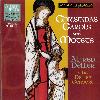
Alfred Deller 阿尔雷德.戴勒 -《圣诞颂歌和经文歌》(Christmas Carols and Motets)4CDs 更新完毕[FLAC]
电驴资源
| 用户共享的电驴资源列表 | |
|---|---|
| Alfred.Deller.-.[The.holly.and.The.ivy.-.CD1].专辑.(Flac).rar | 219.93 MB |
| Alfred.Deller.-.[Hark,Ye.shepherds.-.CD2].专辑.(Flac).rar | 221.78 MB |
| Alfred.Deller.-.[Carol.and.Motets.for.the.Nativity.-.CD3].专辑.(Flac).rar | 236.53 MB |
| Alfred.Deller.-.[Carol.and.motets.of.medieval.Europe.-.CD4].专辑.(Flac).rar | 208.73 MB |
| 886.97 MB | |
电驴资源简介
专辑英文名: Christmas Carols and Motets专辑中文名: 圣诞颂歌和经文歌艺术家: Alfred Deller 阿尔雷德.戴勒古典类型: 全集作品资源格式: FLAC版本: 4CDs 更新完毕发行时间: 2008年10月14日简介:

发行公司:Vangaurd Classics
专辑介绍
这是一套假声男高音鼻祖阿尔雷德.戴勒的圣诞CD,里面有出自名家亨德尔的普世欢腾、门德尔松的听啊!天使高声唱,有流行多年的经典圣诞曲目,天使初报圣诞假音、平安夜、齐来众信圣徒等等。
Countertenor
意大利盛行阉人歌手,英国则是假声男高音嗓音之乡,阉人歌手从歌剧舞台销声匿迹时,英国的假声男高音虽也处于没落状态,但从未完全消失,一直延续至今。第二次世界大战后,欧洲盛行一种古乐表演流派,演唱早期的声乐作品,歌唱方法和声音效果力求恢复古乐的原貌,尽可能真实地再现古乐纯正之美。于是,假声男高音得以借复古之势重现乐坛,这要归功于英国假声男高音歌唱家阿尔雷德.戴勒(Alfred Deller,1912—1979)的率先倡导及其歌唱艺术。
假声男高音,音域一般都超过正常声域,在高声区采用一种头声区发声方法,这是一种有气息支持和共鸣效果的歌唱方法,声音结实有力,几乎具备乐器般纯净、清脆的音色,声响特殊。(史君良《唱片里的声乐艺术》 人民音乐出版社)
Deller Alfred
1912–1979, 假声男高音的鼻祖。起初在教区教堂做唱诗班歌手。1940–47 ,在Canterbury Cathedral工作,1947 被指派到伦敦的St. Paul's Cathedral唱诗班工作。Deller不同寻常的声音非常适合文艺复兴时期的音乐以及Handel和Purcell的。1948年,组建了Deller Consort,表演了文艺复兴、中世纪和巴洛克时期的音乐;录制了大量的录音并在世界各地举行表演。
Yodel,约德尔唱法
瑞士和奥地利的阿尔卑斯山地区流行的一种特殊的唱法和歌曲。演唱时由低沉的真声急剧转换成很高的假声(或其反)。在低音区用低元音,如a, o等;在高音区用高原因,如i, ü等。这种唱法亦见于非洲某些山区和森林区居民。中国京剧中的小生也使用类似的唱法,异显示男生变声期的特点。(汪培元)
Alfred Deller
From Wikipedia, the free encyclopediaJump to: navigation, search
Alfred Deller
Born 31 May 1912(1912-05-31)
Margate, Kent, UK
Died 16 July 1979(1979-07-16) (aged 67)
Bologna, Italy
Nationality English
Occupation Singer
Years active 1940–1979
Alfred George Deller CBE (31 May 1912 – 16 July 1979), was an English singer and one of the main figures in popularizing the return of the countertenor voice in Renaissance and Baroque music during the 20th Century.
Deller was born in Margate, a seaside resort in Kent. As a boy, he sang in his local church choir. When his voice broke, he continued singing in his high register, eventually settling as a countertenor. Throughout the 19th century, it was only in the tradition of all-male cathedral choirs that the countertenor voice had survived.[1] Deller was himself successively a member of the choirs of Canterbury and St. Paul's Cathedrals (1940–47 and 1947–62, respectively). He emerged as a soloist from this choral tradition, largely as a result of the admiration of the composer Michael Tippett, who heard him while at Canterbury and recognized the unique beauty of his voice. Tippett introduced him to the public as a countertenor, rather than a male alto. He also became better known with a radio broadcast (on the BBC's new Third Programme ) of Henry Purcell's Come ye Sons of Art. He concentrated on popularizing and recording the music of English Baroque and Renaissance music by composers such as John Dowland and Purcell.[2]
Deller's voice sounded remarkably high. Misconceptions about the countertenor voice were common at the time Deller was first gaining significant notice as a singer, which was only a matter of decades after the last castrati had died; Michael Chance tells the story that once, a French woman, upon hearing Deller sing, exclaimed Monsieur, vous êtes eunuque —to which Deller replied, I think you mean 'unique,' madam. [3]
He formed the Deller Consort in 1948, a group dedicated to historically informed performance. The group significantly expanded popular notions of the Baroque repertoire, producing high-quality authentic period performances of the works of Bach, Handel, Purcell, Dowland, and even folk songs; the membership of the consort changed over the years. It included various baritones and tenors, sopranos April Cantelo and Mary Thomas, and, from 1964, Deller's son, Mark Deller[1]. (Mr. Deller's other son, Simon, trained as a music teacher during the 1960s.) In 1972, The Deller Consort performed for the Peabody Mason Concert series in Boston.[4] As well as directing the Consort, Deller also conducted some performances with chamber orchestras.
In 1960, Deller sang the role of Oberon in Benjamin Britten's opera A Midsummer Night's Dream. Britten wrote this role with Deller specifically in mind, although he was dropped from staged revivals of the work against the composer's wishes, probably because of poor acting technique.[2] He did record the opera, with the composer conducting.
Lutenist Desmond Dupré performed with him, initially as a guitarist; other accompanists included harpsichordist and musicologist Walter Bergmann. In later years, he worked with lutenist Robert Spencer and harpsichordists Harold Lester and William Christie. His recordings include the lute songs of Dowland, operas by Handel, Britten's A Midsummer Night's Dream, songs and semioperas by Purcell (such as The Fairy Queen), traditional English folk songs, works by Thomas Tallis, and the Bach alto repertoire. He recorded for HMV, Vanguard Classics, and Harmonia Mundi.
Deller died while vacationing in Bologna, Italy.